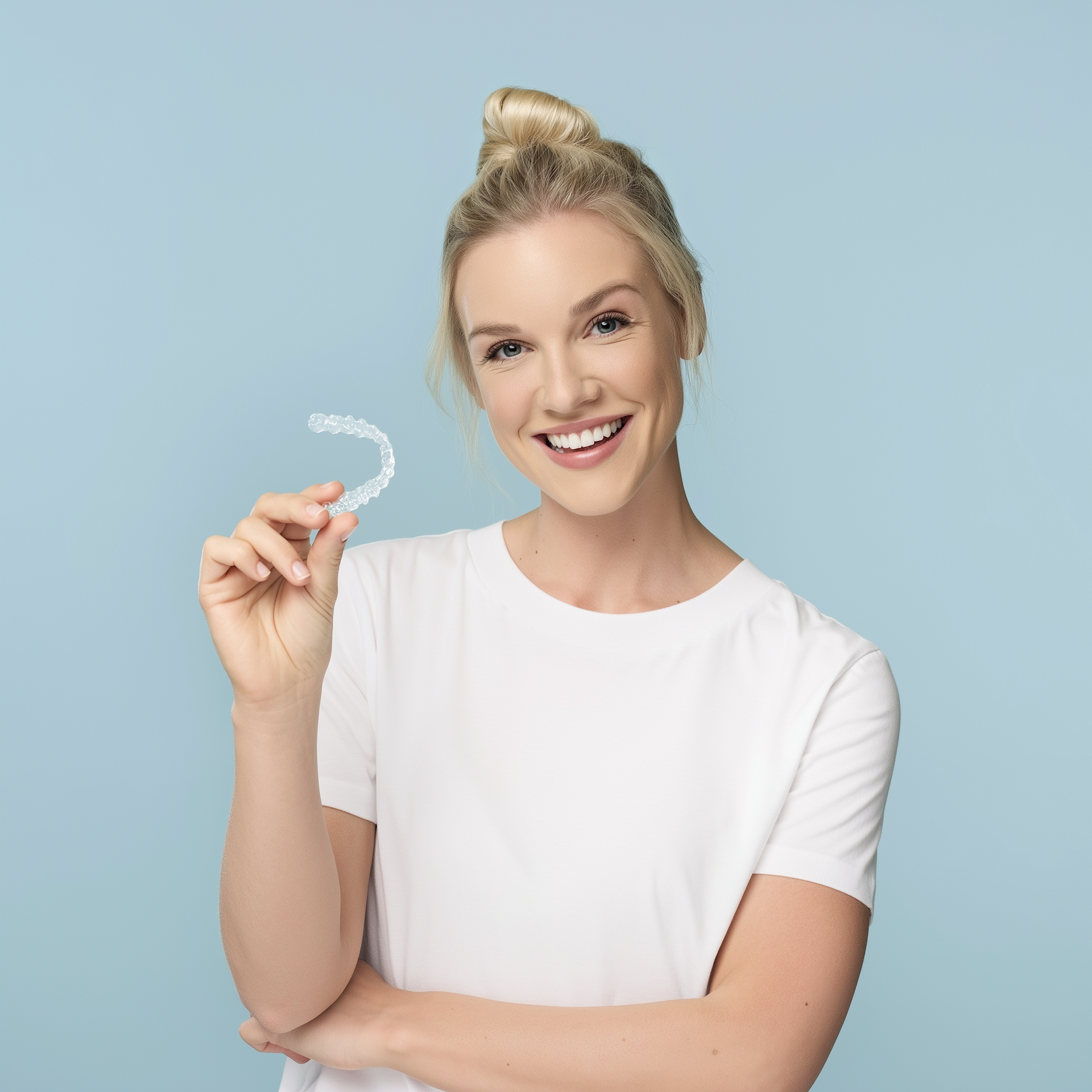
Learn why more adults are choosing braces and Invisalign to improve their confidence, oral health, and long-term smile.
KEY TAKEAWAYS
- Age doesn't determine your eligibility. Healthy gums and healthy supporting bone are.
- Adult teeth move roughly 1.5 times more slowly than a teenager's, which adds about four to twelve months to treatment.
- An estimated 1.91 million adults were in active treatment with member orthodontists in the United States in 2024, up from 1.64 million two years earlier.
- Crowns, bridges, implants, and past gum recession rarely rule out treatment. They change the plan, which is why an in-person exam comes first.
- Teeth that shifted after childhood braces are one of the most common reasons adults come back, and those cases are often the quickest to treat.
You notice it on a video call. Your lower front teeth look more crowded than they did a few years ago, and you are certain they were straight when your braces came off in high school.
Or maybe you never had braces at all, and you have spent two decades angling your face in photographs.
Dr. Cathleen George completed her orthodontic training at the University of Pennsylvania, where she continues to teach future orthodontists and participate in clinical research. Dr. Jordan Cogan earned a master’s degree in oral biology alongside his orthodontic certificate at Temple University. Together, their expertise means the way bone responds to pressure is not a footnote in our practice; it is a central reason adult cases are planned differently here.
Adult orthodontics is not children's orthodontics started late. Teeth move by the same process at every age, but the tissue around them behaves differently after growth stops, and a plan that ignores that difference is the plan that disappoints people.
Is It Too Late to Get Braces as an Adult?
No. There is no upper age limit on orthodontic treatment. The American Association of Orthodontists(AAO) states it plainly: being older does not prevent you from getting orthodontic treatment.
What matters is the foundation. Teeth move through bone, so the gums and the bone holding your teeth in place have to be healthy enough to support that movement.
Adults now make up a large share of the people in treatment. In 2024, AAO member orthodontists in the United States were treating an estimated 1.91 million adults, up from 1.64 million two years earlier.
We see that shift in our own chairs in Richboro and Yardley. A parent brings a child in for a consultation, and somewhere near the end of the visit asks, a little sheepishly, whether anything can be done about their own teeth.
The answer is almost always yes.
What Makes Adult Treatment Different From Treating a Teenager?
Three things. Your jaw has finished growing, your bone is denser than it used to be, and your mouth already has a history of dental work, wear, and habits.
Your teeth move more slowly, and that is normal
A 2024 review in the International Journal of Oral Science found that adult teeth move roughly 1.4 to 1.6 times more slowly than adolescent teeth, and that adult treatment typically runs four to twelve months longer as a result.
The explanation is in the bone. Adult alveolar bone, the bone that forms the tooth sockets, is denser and remodels less readily, and the ligament around each root carries fewer cells and blood vessels than it did at fifteen.
This is not a problem to be solved. It is a timeline to be planned for honestly, which is why we would rather give you a realistic range at the start than a flattering one.
The tissue around your teeth has a history
Gum recession, past gum disease, old fillings, and years of clenching all change what is possible and how we sequence the work.
One example we talk through often is the open gingival embrasure, better known as a black triangle. It is a small dark gap that can appear between teeth near the gumline once long-standing crowding is corrected. The same review reports these appear in 22 to 38 percent of adult patients and are rare in adolescents.
We would rather you hear that from us beforehand than find it in a mirror afterward. In many cases, planning can reduce the risk, and if your case carries it, we will tell you.
Growth is no longer on our side
With a growing child, we can guide the jaws while they develop. That window closes in adulthood, so a significant difference in jaw size is corrected either by moving teeth to compensate or, in a small number of cases, with an oral surgeon.
Most adult cases need nothing like that. It is worth naming because it is one of the honest limits of what braces alone can do once growth is finished.
Can I Get Braces If I Have Crowns, Bridges, or Implants?
Usually yes. Crowns, veneers, implants, and bridges do not rule out orthodontic treatment, but they do change how we plan the case. This is one of the questions we hear most often at consultations, and it is a good reason to ask it in person rather than to guess from a list of frequently asked questions.
Brackets bond differently to porcelain than to natural enamel, so those teeth need a different preparation. An implant fuses directly to the bone and cannot be moved, so the plan is built around it.
A bridge connects two or more teeth into a single unit, which means they move together or not at all. Sometimes your general dentist will place a temporary restoration so the teeth can be moved, then rebuild the final one afterward.
That coordination is routine. Dr. Cathleen George founded an interdisciplinary study club for dental specialists in this area for exactly this reason. Adult cases go better when the orthodontist, general dentist, and periodontist plan together rather than in sequence.
What If My Teeth Shifted After Braces as a Teenager?
This is one of the most common reasons adults come to see us, and it is not a sign that your first round of treatment failed.
Teeth move throughout life. Lower front teeth in particular tend to crowd again with age, and a retainer worn faithfully for two years after high school was never going to hold that back for thirty.
Second-time treatment is often shorter and simpler than the first, because the underlying bite is usually still correct. Many of these cases are handled with Invisalign clear aligners in well under a year.
What changes the long-term outcome is what happens after. Retention is not the end of treatment. It is the maintenance plan for the rest of your life.
Braces or Invisalign as an Adult?
Both work. The choice comes down to how your teeth need to move, how visible you want your treatment to be, and how reliably you can wear something you can take out.
| Braces | Invisalign | |
|---|---|---|
| How it works | Brackets and a wire apply steady, continuous pressure that you cannot interrupt. | Removable clear trays move the teeth in a series of small planned steps. |
| Visibility | Metal brackets are noticeable. Clear brackets are less so. | Difficult to see at conversational distance. |
| Typical timeline in our practice | About 18 to 36 months, depending on the case. | About 12 to 18 months for most cases. |
| What it asks of you | Nothing to remember. The appliance works whether you think about it or not. | 20 to 22 hours of wear a day, every day. |
| Well suited to | Complex rotations, meaningful bite correction, and cases where consistent wear would be a challenge. | Mild to moderate crowding, spacing, relapse cases, and adults who need treatment to stay discreet at work. |
| Eating and cleaning | Some foods are off limits. Brushing and flossing take more care. | Trays come out to eat and brush, so nothing is off the menu. |
If you commute to Philadelphia or Princeton and spend your day in meetings, discretion is a practical clinical consideration, not vanity. It affects whether you actually finish treatment, and an abandoned plan helps nobody. You can compare finished results on our before-and-after page.
For the mechanics of each option, our braces and Invisalign pages go into more detail.
What We Check Before Adult Treatment Starts
Adult treatment starts with an evaluation. We look at five things before anything is bonded or scanned.
BEFORE WE BEGIN
- Gum health. Active gum disease is treated first. Moving teeth through inflamed tissue can accelerate bone loss instead of correcting anything.
- Bone support. X-rays show how much bone supports each root, which sets the real limits on how far a tooth can safely move.
- Existing dental work. Crowns, bridges, implants, and older restorations shape the treatment sequence.
- Grinding and jaw joint symptoms. Clenching patterns change how we stage tooth movement and what we plan for retention.
- Your actual goal. Straightening only the teeth that show is rarely the right answer. The AAO cautions that moving front teeth alone can affect the bite and the bone that supports it.
Gum health is worth a word of reassurance. The American Dental Association(ADA) reports that 47.2 percent of adults over 30 in the United States have chronic periodontitis. It is common, it is treatable, and treating it first is what makes orthodontic treatment safe rather than risky.
How Long Does Adult Treatment Take?
Most adult cases in our practice run about 12 to 18 months with Invisalign and about 18 to 36 months with braces. Cases where teeth have simply shifted back after childhood treatment are frequently shorter.
Three things move that number: how far the teeth have to travel, whether the bite needs correcting as well as the teeth, and how consistently you wear what we give you.
What Does Adult Treatment Cost, and Will Insurance Help?
Cost depends on the appliance and the complexity of the case, which is why we give you an exact figure at the consultation instead of a range on a web page.
Many adult dental plans include an orthodontic benefit, though it is usually structured as a lifetime maximum rather than an annual one. We accept most insurance plans and will verify your benefit before you commit to anything.
We also offer extended payment plans and no-interest financing. You may also be able to use a flexible spending account or health savings account. Rules vary by plan, so check with your administrator.
Why Families Choose Us
- Two board-certified specialists. Dr. Cogan and Dr. George are both Diplomates of the American Board of Orthodontics, a voluntary certification that requires examination well beyond the orthodontic degree itself.
- Depth in the biology, not just the appliance. Dr. Cogan holds a master's degree in oral biology from Temple University and graduated first in his dental class. Dr. George instructs new orthodontic doctors in the University of Pennsylvania's orthodontic department and takes part in clinical trials of emerging technology.
- Built for coordinated adult care. Dr. George founded an interdisciplinary study club for dental specialists in this area. Adult cases involving crowns, implants, or gum treatment depend on exactly that kind of coordination.
- Two offices, one commute away. Richboro and Yardley, so you can choose the location that fits your workday.
- 3D imaging before decisions get made. We plan from actual images of your teeth and roots, which matters more in adult cases where bone support is the limiting factor.
- Experience you can check. More than 25 years of specialized orthodontic experience and more than 560 five-star Google reviews from families across Bucks County.
Transform your smile, transform your life!
CG Orthodontics has been straightening teeth in Bucks County for more than 25 years. We treat adults, teenagers, and children from Yardley, Richboro, Newtown, Lower Makefield and the surrounding communities, including families across the Council Rock and Pennsbury school districts.
Your consultation is free, and our team cannot wait to meet you.
Richboro: 51 Almshouse Road, Richboro, PA 18954
Yardley: 1703 Yardley Langhorne Road, Yardley, PA 19067
Call 215-355-5995 or schedule your free consultation online.
Frequently Asked Questions
Am I too old for braces?
No. There is no upper age limit for orthodontic treatment. What determines whether you can be treated is the health of your gums and the bone supporting your teeth, not the number of birthdays behind you. We treat adults of all ages every year.
Do braces work more slowly on adults?
Yes, somewhat. Research published in the International Journal of Oral Science in 2024 found that adult teeth move about 1.4 to 1.6 times more slowly than adolescent teeth, which adds roughly four to twelve months to treatment. The result is the same. The timeline is longer.
Can I get Invisalign if I had braces as a teenager and my teeth shifted?
Usually yes, and these are often among the quickest cases we treat. Because the underlying bite is typically still correct, relapse cases frequently involve minor crowding that aligners handle well, sometimes in under a year. A retainer plan afterward is what protects the result.
Will braces damage my gums if I already have some recession?
Not when the case is planned for it. Existing recession and past gum disease need to be stable before treatment begins, and treated first if they are not. We may also coordinate with your periodontist. Moving teeth through inflamed tissue causes harm, not the braces themselves.
Does dental insurance cover adult orthodontic treatment?
Often, at least in part. Many adult plans include an orthodontic benefit, though it is usually a lifetime maximum rather than a yearly one. We accept most insurance plans and will verify your benefit before you commit to anything. Payment plans and no-interest financing are available.
Sources
1. American Association of Orthodontists. Member Survey Indicates Orthodontic Patient Numbers at All-Time High (2025 Economics of Orthodontics and Patient Census Survey, reporting 2024 data). Published July 9, 2025. www2.aaoinfo.org/member-survey-indicates-orthodontic-patient-numbers-at-all-time-high
2. American Association of Orthodontists. Adult Orthodontics: Smile with Confidence at Any Age. aaoinfo.org/adult-orthodontics
3. Zhang, Y., Yan, J., Zhang, Y., Liu, H., Han, B., and Li, W. (2024). Age-related alveolar bone maladaptation in adult orthodontics: finding new ways out. International Journal of Oral Science , volume 16. DOI: 10.1038/s41368-024-00319-7. doi.org/10.1038/s41368-024-00319-7
4. American Dental Association. Gum Disease. MouthHealthy. mouthhealthy.org/all-topics-a-z/gum-disease
5. American Association of Orthodontists. Orthodontists Respond to Frequently Asked Questions from Adults Considering Treatment. aaoinfo.org/orthodontists-respond-to-frequently-asked-questions-from-adults-considering-treatment